Free shipping to the US and Canada · 30-day money-back guarantee
Fragrance-free30-day money-back guaranteeFree shipping
4.8 · 8,000+ happy customers

You shower every day. So why don't you smell like you anymore?

The musty "old person smell" isn't about being clean. It's a change in your skin that regular soap was never made to wash off. Here's what's really happening, and the Japanese soap made for it.

Made in Japan · Fragrance-free · Gentle on mature skin

Venturi Beauty Original Persimmon Soap
Fresh pillowcase, where some people first notice a lingering musty smell

Have you noticed it here?

  • On your pillowcase, even after a few nights
  • On the collar of a blouse you only wore once
  • On a cardigan or scarf you love
  • Behind your ears, or at the back of your neck
  • In the car, on the headrest
  • On a hairbrush or a hat
  • In a bedroom that's been closed up for a day

If you checked even one, you've met it.

01 / Recognition

It usually starts with a pillowcase.

You strip the bed and catch it. A faint smell on your pillowcase. A little musty. A little stale. Not dirty, exactly. Just not you.

At first you blame the laundry. Then you notice it in other places.

And part of you already knows what it is.

It's the smell of your grandmother's house. Of a nursing home hallway. The smell you noticed on older relatives when you were young and promised yourself you would never have.

Now you're the one doing everything right. You shower every day. You use good soap. You wash your sheets. And it's still there.

Here's the part nobody explains: this has nothing to do with how clean you are. It's chemistry. And once you understand it, the fix makes complete sense.

02 / The reason behind the smell

It's not your hygiene. It's your skin's oil changing.

Understanding what's happening is the first step toward feeling like yourself again.

What changes after 40

Your skin makes a thin layer of natural oil every day. It keeps your skin soft and protected. You never think about it.

But as we get older, the mix of that oil changes. It starts to contain more of a certain kind of fat. At the same time, your skin's natural defenses against air and sunlight get weaker.

When that fat meets the air, it slowly breaks down. And when it breaks down, it turns into a compound with a very particular smell.

The compound has a name: 2-nonenal

In 2001, researchers in Japan studied the body odor of men and women of different ages. They found a compound called 2-nonenal in people over 40, and not in the younger people they tested. The older the person, the more of it they tended to find.

Its smell is often described as greasy, grassy, or like old cardboard. Most people simply call it musty. It's the smell you know from older relatives' homes.

In Japan the smell is so familiar it has its own everyday word: kareishu, which means the scent of aging.

Close-up of mature woman's neck, illustrating where skin oil can collect
2-nonenalThe compound linked to age-related body odor
Why it clings

Why it clings to everything

Nonenal isn't sweat, and it isn't dirt. It comes from oil, and it behaves like oil. It doesn't rinse away with water. It sticks to skin, hair and fabric.

That's why you notice it on pillowcases and collars before anywhere else. Fabric holds it, so it builds up night after night.

It's also why it comes from places you might not expect. The skin on your neck, chest, upper back, behind your ears and along your hairline makes the most oil, so that's where the smell is strongest. Not just your underarms.


Older woman thoughtfully looking into a bathroom mirror
Why you miss it

Why you can't smell it on yourself

Your nose is built to tune out smells that are always there. It's the same reason you can't smell your own home the way a guest does the moment they walk in.

The smell on your skin is with you all day, every day. So your nose stops reporting it. The people who hug you, sit beside you, or share your bed haven't tuned it out. They notice it right away.

That's why so many people first find out from a grandchild, a partner, or a pillowcase.

Why attempts fail

Why everything you've tried hasn't worked

None of these are wrong. They're just made for a different problem.

You were never dirty. Your soap just wasn't made for this.
Why nothing else lasted

Why everything you've tried hasn't worked

Each fix addresses a different problem. Here's why the smell can come back.

What you triedWhat it's made forWhy the smell comes back
Longer, hotter showersRinsing off sweat and dirtWater slides over an oily layer, and hot water dries out mature skin
Regular soap or body washLifting sweat and everyday dirtIt isn't made for this compound, so you get clean but not fresh
Antibacterial soapKilling germsThis smell comes from oil breaking down, not mainly from germs
Stronger deodorantUnderarm sweatThe smell comes from your neck, chest, back and scalp too
Perfume or body sprayAdding a scent on topIt covers the smell for an hour, then people notice both
Washing the sheets moreClean fabricClean fabric picks it up again the very next night

None of these are wrong. They're just made for a different problem.

You were never dirty. Your soap just wasn't made for this.
Hands preparing garlic in the kitchen
A simple comparison

Think of garlic on your hands

You chop garlic, then wash your hands with soap. They're clean. They still smell like garlic.

You can wash them three more times and it won't change, because the smell isn't dirt. It takes something that grabs that particular smell to get it off.

The musty smell of aging skin works the same way. That's where persimmon comes in.

03 / The Japanese answer

Japan solved this a long time ago.

In Japan, the smell of aging skin is something people talk about openly. It has a name. And it has a traditional answer: soap made with persimmon.

Not the sweet, ripe fruit. The unripe one.

Japanese persimmon soap and botanicals
The key ingredient

Why unripe persimmon

Bite into an unripe Japanese persimmon and your whole mouth puckers. That dry, gripping feeling comes from tannin, a natural plant compound unripe persimmons are packed with. As the fruit ripens, it loses that grip.

That gripping power is exactly what makes persimmon tannin useful. It binds to odor molecules and neutralizes them, so the smell comes off with the lather instead of being covered up.

Kakishibu: a Japanese tradition

For centuries, Japanese craftsmen have pressed unripe persimmons and left the juice to ferment and age. The result is called kakishibu.

It was used to waterproof paper umbrellas and fishing nets, to protect wood, to dye cloth, and even to help make sake. Every home knew it. It was simply part of daily life.

That same fermented persimmon tannin is the heart of this soap.

Three steps / One shower

What happens in your shower

It's not another scent layered over the problem.

  1. Lather.

    The persimmon tannin spreads over your skin, reaching the oily layer where the musty smell lives.

  2. Neutralize.

    For one full minute of lathering, the tannin binds to the odor molecules.

  3. Rinse.

    The smell washes down the drain with the lather. What's left is clean skin that smells like you.

Not covered up. Washed away.
04 / The ingredients

Four ingredients. One to end the smell. Three to protect your skin.

Tannin grips. That's what makes it work on odor. But on its own, anything that grips can leave mature skin feeling dry and tight.

So the persimmon is balanced with three ingredients chosen for skin over 50. The result is a bar strong enough for the smell and gentle enough to use every day, on your body, face and hair.

Fermented Japanese persimmon (kakishibu)

The heart of the bar. Its natural tannin binds to the musty odor and neutralizes it, so it rinses away.

Japanese persimmon fruit

Shea butter

A rich, natural butter from the nut of the African shea tree. It soothes dry, mature skin and leaves it soft.

Shea butter

Olive fruit oil

The same oil cooks have trusted for centuries, here for your skin. It adds deep moisture and comfort.

Olive fruit oil

Glycerin

Draws water into your skin and holds it there. It's why the bar rinses clean without that tight, squeaky feeling.

Glycerin illustration

What's not in it matters just as much

  • No fragrance. Nothing is added to make it smell like anything. You won't smell like fruit or perfume. You'll smell like you.
  • No artificial color. Its soft amber color comes from the persimmon itself.

Made in Japan

Every bar is made in Japan, where persimmon soap for the scent of aging is a familiar, everyday product. Each one is a round 100 g bar that sits comfortably in your hand and lathers easily in warm water.

After your shower, your skin feels clean and soft. Not tight, not itchy, not stripped.

05 / Not all persimmon bars are the same

If you tried persimmon soap before and it didn't work, read this.

Once persimmon soap became popular, copies followed fast. Bright orange bars. "Persimmon scent." Two for ten dollars.

Here's the problem. A persimmon smell does nothing for the musty smell. Only persimmon tannin does. And real tannin doesn't make a bar smell like fruit or glow neon orange.

If persimmon soap didn't work for you before, there's a good chance you never had the real thing.

How to tell the difference in 10 seconds

01 / Ingredient

Look for kakishibu or persimmon tannin by name.

"Persimmon extract" at the end of a long list, or "persimmon scent," isn't the same thing.

02 / Fragrance

Check for added fragrance.

Fragrance is there to make you think it's working. It covers the smell for an hour and adds another scent on top.

03 / Colour

Look at the color.

Real persimmon tannin gives a soft, natural amber. Neon orange comes from dye.

04 / Origin

Check where it's made.

Kakishibu is a Japanese tradition. Ours is made in Japan.

Real persimmon soap versus cheaper alternatives

What actually matters when you're choosing a bar.

What mattersOur persimmon soapCheap persimmon soapRegular soap or body wash
Made for the musty smell of aging skin✓Sometimes✕
Real fermented persimmon tannin (kakishibu)✓Not always✕
Made in Japan✓Not alwaysVaries
Fragrance-free✓Often perfumedVaries
No artificial color✓Often dyedVaries
Gentle on mature, dry skin✓Often dryingVaries
30-day money-back guarantee✓Varies✕

Other products and formulas vary; compare individual ingredient lists and policies.

06 / How you'll know

You can't smell your skin. But you can smell your pillowcase.

Your nose has tuned out your own scent, so we don't ask you to trust it. We ask you to trust fabric, which holds the smell night after night.

The pillowcase test
Proof is on
your pillowcase.

Your bedroom can show you what your nose is used to ignoring.

The pillowcase test

  1. Before your first wash, put a fresh pillowcase on your pillow. Sleep on it for three nights. Fold it into a plastic bag and seal it.
  2. Start the soap in your daily shower. Put on another fresh pillowcase and sleep on it for three nights.
  3. Open the bag and compare. Smell the old pillowcase, then the new one. Most people can smell the difference within about a week.

The collar check.

Smell the collar of a blouse after a day of wear, then compare it to one you wore before you started.

Ask someone you trust.

Tell your daughter, partner or a close friend you're trying a new Japanese soap and want an honest opinion. You're asking about a soap, not about yourself, which makes it an easy question.

And then there's the test you never have to set up. The grandchild who climbs into your lap and stays. The partner who moves a little closer. That's the one that matters most.
How to use it

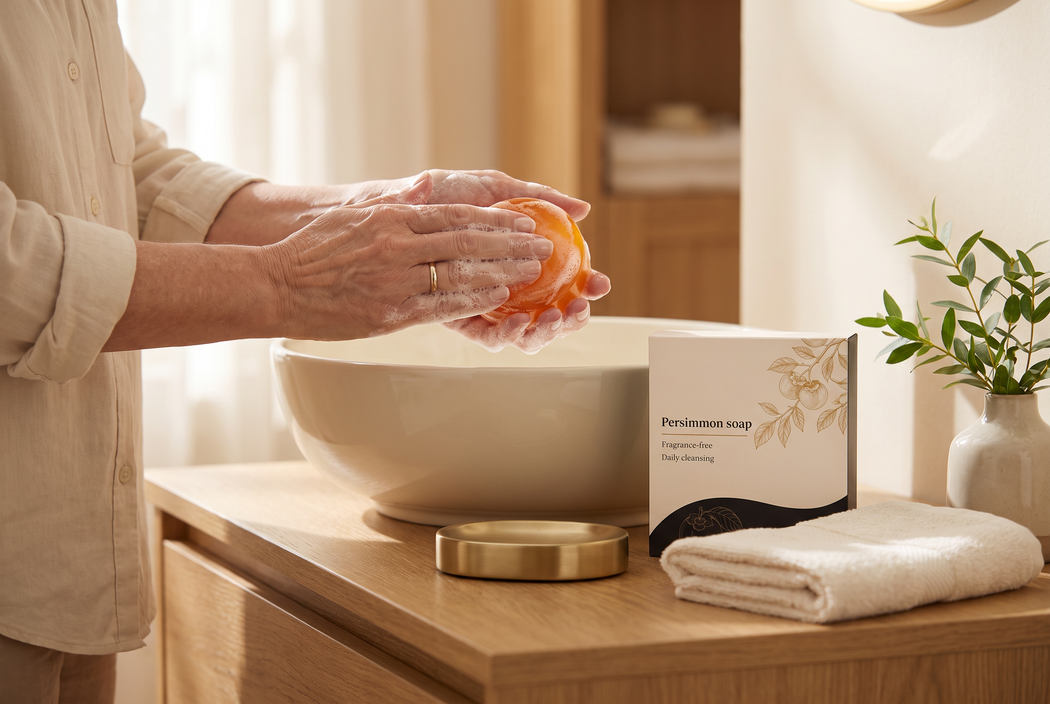
One minute in the shower you already take.

  1. Wet the bar and lather it in your hands, on a washcloth, or in the exfoliating pouch.
  2. Wash where the smell lives: the back of your neck, behind your ears, your chest, upper back, underarms and along your hairline.
  3. Keep lathering for one full minute. This is the time the persimmon needs to do its work.
  4. Rinse and pat dry. Use your usual moisturizer if you like one.
  5. Let the bar dry on a draining dish between uses. A dry bar lasts much longer.
How to use persimmon soap in a daily shower
It's gentle enough for your face and hair too. In your first week, wash your pillowcases, sheets and favorite tops once, so the old smell in the fabric doesn't transfer back to clean skin.
What to expect

One bar. A simple new daily habit.

Your first shower

Your skin feels clean and soft, not tight. No perfume left behind.

Within about a week

Most people notice the musty smell is gone from their pillowcase and collars. Some notice sooner.

Every day after

Your skin keeps making the same oil, so the smell would slowly come back without it. One minute a day keeps it gone, the same way shampoo keeps your hair clean.

One bar

A 100 g bar lasts about 30 to 45 days of daily use.

07 / Your questions, answered honestly

Your questions, answered honestly.

Everything you've been wondering, from the chemistry to using your first bar.

Is this smell really a thing, or is someone trying to scare me into buying soap?

It's real, and it's been studied. In 2001, researchers in Japan identified the compound behind it, 2-nonenal, and found it in people over 40. Japan even has an everyday word for it, kareishu. It's common, it's natural, and it isn't a sign that you've done anything wrong.

I shower every day. Why would I need this?

Because showering isn't the problem. The smell comes from your skin's natural oil breaking down as it meets the air. That oily residue doesn't rinse off with water, and regular soap isn't made to lift it. You can be completely clean and still carry it. This soap is made for exactly that.

How do I know if I have it?

Most people can't smell it on themselves, because the nose tunes out its own scent. Check fabric instead: your pillowcase after a few nights, the collar of a blouse, a cardigan, the headrest in your car. A musty, stale or cardboard-like smell there, even though you're clean, is the sign.

Isn't this just body odor from sweat?

No. Sweat odor comes mostly from your underarms and goes away when you wash. This smell comes from oil on your neck, chest, upper back, scalp and behind your ears, and it hangs on after a shower. That's why deodorant doesn't touch it.

Can't I just use more deodorant or perfume?

Deodorant is made for underarm sweat, and this smell comes from other places. Perfume sits on top of it for an hour or so, and then people notice both. Neither one removes it. This soap does.

I tried persimmon soap before and it didn't work. Why would this one?

Some cheap bars are mostly ordinary soap with persimmon scent and orange dye. The scent does nothing for the smell. Only real persimmon tannin does. Ours is made in Japan with fermented persimmon tannin (kakishibu), with no fragrance and no artificial color.

Will it dry out my skin?

It's made for mature skin. The persimmon is balanced with shea butter, olive fruit oil and glycerin, so your skin feels soft after you dry off, not tight. If your skin is very sensitive, try it on a small patch of your inner arm first, as you would with any new soap.

What does it smell like?

Nothing. It's fragrance-free, so it won't leave you smelling like fruit or perfume. What's left is clean skin and your own natural scent.

How soon will I notice a difference?

Most people notice within about a week of daily use, and some sooner. Try the pillowcase test so you can tell for yourself.

Do I have to keep using it?

Yes, the same way you keep using shampoo. Your skin keeps making the same oil, so the smell slowly returns without it. One minute a day in the shower keeps it gone.

Can I use it on my face and hair?

Yes. It's gentle enough for both. Focus on where the smell is strongest: the back of your neck, behind your ears, your chest, back and hairline.

Can I still use my body wash?

Yes. Use this soap on the areas where the smell lives, then anything else you love.

Can men use it?

Yes. Men get the same smell and the soap works the same way for them. Couples can simply share a bar.

How long does one bar last?

A 100 g bar lasts about 30 to 45 days of daily use. Keeping it dry on a draining dish between showers helps it last longer.

Why does it cost more than drugstore soap?

Because it's made in Japan with real fermented persimmon, not fragrance and dye. And because a bar lasts a month or more, it works out to less per day than a cup of coffee. Compare that to what you've already spent on perfume, sprays and deodorants that only covered the smell.

Is this a subscription?

No. You pay once. Nothing renews, and you'll never be charged again unless you place a new order.

What are the free gifts?

Every bundle comes with a free gift: a bamboo soap dish, an exfoliating soap pouch, or a travel tin. Choose 6 bars or more to get all three.

Will anyone know what's in the package?

No. It arrives in a plain mailer, and nothing on the soap's own box mentions odor. On your bathroom shelf, it just looks like a lovely Japanese soap.

Can I buy it for my mother without offending her?

Yes. Nothing on the package says what it's for. You can simply say, "I found this Japanese soap I love, so I got you one too." The 10-bar bundle makes it easy to keep some and share some.

I don't think I have the smell yet. Is it worth starting?

Some women start early because they remember the smell from a parent's or grandparent's house and don't want it. It's an easy daily habit, and it's gentle enough to use long before you notice anything.

Could the smell be something medical?

The smell this soap is made for is slow and musty. It creeps in over years, shows up on pillowcases and collars, and is there even when you're clean. If a strong smell came on suddenly, smells sweet or fruity, smells like ammonia, or comes with other changes in how you feel, please talk to your doctor first. Those can have causes no soap should cover up.

How fast will it arrive?

Shipping is free to the US and Canada. Orders usually arrive within 6 to 11 days.

What if it doesn't work for me?

You're covered by our 30-day money-back guarantee. If you don't notice the difference, email support@venturibeauty.store and we'll refund your order. You don't need to send anything back.

TRY IT
RISK-FREE
30 DAYS
08 / The guarantee

Notice the difference, or don't pay.

Use the soap every day for 30 days. Do the pillowcase test. Ask someone close to you.

If you don't notice the difference, email us at support@venturibeauty.store and we'll refund your order. You don't need to send anything back. No forms, no arguing, no hard feelings.

We can promise this because the result isn't a feeling you have to talk yourself into. The smell is either on your pillowcase or it isn't.

09 / Reviews

What it feels like to smell like yourself again.

4.8 · 8,000+ happy customers
Customer review feed
Photo reviews first. Genuine customer reviews will appear here after the store's verified review feed is connected.

Individual experiences vary. The rating and review count above are placeholders pending verification.

10 / A fresh start

You've always been the clean one. Smell like it again.

You've spent your whole life taking care of yourself. You were never the person anyone had to worry about.

You shouldn't have to start wondering now. Whether your grandchild will scrunch up her nose. Whether your partner noticed. Whether a friend pulled back from that hug a little sooner than she used to.

Now you know the truth. The smell isn't your fault. It's an oily layer your regular soap was never made to lift. Japan has been washing it away with persimmon for years, and now you can too.

No perfume. No cover-up. Just you.

Washes away the musty smell regular soap leaves behind Real fermented Japanese persimmon, made in Japan Fragrance-free and gentle on mature skin Free gift with every bundle Free shipping in a plain mailer 30-day money-back guarantee
Original Persimmon Soap

The daily Japanese persimmon bar for feeling like yourself again.

Smell Like Me Again  →

Try it for 30 days. If you don't notice the difference, you get your money back.

Free shipping · 6–11 day delivery · Individual results vary.